For hikers and outdoor enthusiasts, clean water on the trail is essential. This guide highlights five top-rated water filter bottles that balance filtration power, weight, and convenience. Each option uses a distinct filtration approach—from microfilters and hollow-fiber membranes to purifier cartridges—so you can choose based on water sources and how you hike. Below is a quick summary table of the chosen models, followed by detailed sections to help you compare performance, maintenance, and practical use on long treks or quick day hikes.
| Product | Brand | Capacity | Key Benefit |
|---|---|---|---|
| LifeStraw Peak Collapsible Filter Bottle | LifeStraw | 650 ml | Ultra-compact, backwashable microfilter |
| LifeStraw Go Series Water Filter Bottle | LifeStraw | 22 oz | Carbon-enhanced taste and strong bacteria/parasite protection |
| SurviMate 5-Stage Ultra-Filtration Bottle | SurviMate | Depends on bottle variant | Advanced 5-stage filtration with NSF/ANSI 42&372 |
| GRAYL GeoPress 24 oz Water Purifier Bottle | GRAYL | 24 oz | Purifies and cleans water from viruses, bacteria, and chemicals |
| Katadyn BeFree 1.0L Water Filter | Katadyn | 1 L | 0.1 micron EZ Clean membrane for quick maintenance |
id=”life Straw Peak Collapsible Filter Bottle”>LifeStraw Peak Collapsible Filter Bottle

The LifeStraw Peak Series collapsible bottle is designed for backpackers who want a compact, packable water filtration solution. Its 650 ml capacity balances enough hydration with lightweight carrying when space matters. The re-engineered membrane and backwash accessory boost performance against sand and silt, helping the bottle maintain a good flow even as it accumulates particulates from stream water. The kit folds flat when empty, making it easy to stash in a pack without adding bulk.
- Filters out 99.999999% of bacteria (including E. coli and Salmonella) and 99.999% of parasites (including Giardia and Cryptosporidium)
- Removes 99.999% of microplastics, silt, sand, and cloudiness
- Backwash accessory maintains flow and filter life
- Ultra-compact with a strong emphasis on weight savings
- 650 ml capacity for day hikes and light treks
Ideal for day hikes, trail runs, and travel where space and weight matter. The design emphasizes portability without compromising core filtration protection on freshwater sources commonly encountered on well-traveled trails.
id=”life straw go series water filter bottle”>LifeStraw Go Series Water Filter Bottle

The LifeStraw Go Series blends a BPA-free bottle with a multi-stage filtration approach to address everyday travel and outdoor needs. The bottle filters out bacteria, parasites, and microplastics, while the carbon filter enhances taste by reducing chlorine, odors, and organic chemicals. It’s especially practical for travelers who might refill in airports, hotels, or urban areas where water quality varies. The filter system is designed to work reliably when filling from streams, taps, or questionable sources during road trips and hikes.
- Removes 99.999999% of bacteria and 99.999% of parasites; 99.999% of microplastics
- Carbon filter improves taste and reduces odors
- 22-ounce BPA-free bottle for everyday use
- Simple, field-friendly design with straightforward maintenance
With a focus on taste and reliability, this bottle is a solid choice for hikers who want a balance of filtration quality and everyday usability, especially during travel where water quality is uncertain.
id=”surviMate 5-Stage Ultra-Filtration Bottle”>SurviMate 5-Stage Ultra-Filtration Bottle

SurviMate delivers a robust filtration setup with a five-stage process, including a 0.01-micron hollow fiber ultrafiltration membrane and carbon-based purification beads. NSF/ANSI 42 and 372 certifications indicate tested performance against common contaminants and chemical agents. The smaller pore size compared to many other bottles offers higher filtration precision, delivering cleaner, safer drinking water from questionable sources on camping trips, survival scenarios, or remote travel.
- Five-stage filtration with 0.01 μm hollow fiber membrane
- Certified NSF/ANSI 42&372
- Removes chlorine, odors, heavy metals, and sediment
- Built-in compass for navigation convenience on expeditions
For multi-day excursions where water sources vary from streams to lakes, this bottle provides an extra layer of filtration confidence, especially when you must rely on natural sources for extended periods.
id=”grayl-geopress-24-oz-water-purifier-bottle”>GRAYL GeoPress 24 oz Water Purifier Bottle
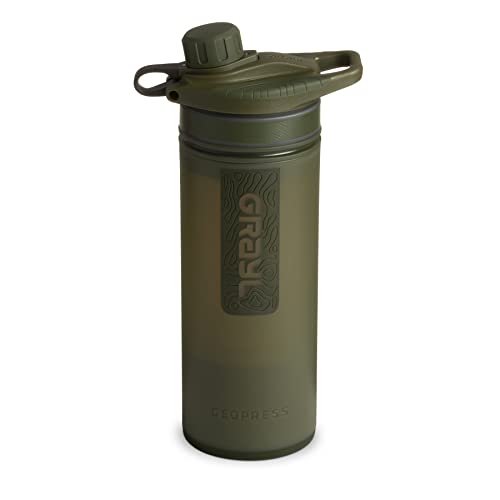
The GrayL GeoPress is a purifier bottle designed to make sketchy water safe to drink on the move. It excels in outdoor adventures such as hiking, camping, or bushcraft, as well as global travel or emergency scenarios. Its “Fill. Press. Drink!” workflow is intuitive, and it removes viruses, bacteria, and protozoa, while also filtering particulates and adsorbing VOCs, PFAS, chemicals, and heavy metals. The purifier approach provides a comprehensive protection profile for water from questionable sources.
- Removes pathogens including viruses and bacteria
- Filters particulates and adsorbs VOCs, PFAS, heavy metals, and chemicals
- Intuitive Fill → Press → Drink operation
- Suitable for global travel and survival situations
GeoPress is well-suited for hikers who prioritize purification capability against a broad range of contaminants and want a straightforward operation that works well even in remote environments.
id=”katadyn-befree-1-0l-water-filter”>Katadyn BeFree 1.0L Water Filter

The Katadyn BeFree 1.0L focuses on ultralight performance for endurance activities such as trail running and fast packing. Its 0.1-micron hollow fiber membrane delivers solid protection against bacteria and protozoa, while the included hydrapak soft-flask collapses for compact travel. The EZ-Clean membrane makes maintenance straightforward, reducing the need for tools or backflushing. This setup is a strong option when weight and speed matter most in alpine or desert environments.
- 0.1 micron hollow fiber membrane removes bacteria and protozoa
- Ultralight design; 63 grams without accessories
- Collapsible Hydrapak Soft-Flask for compact storage
- EZ-Clean membrane for quick maintenance
BeFree suits runners, skyrunners, or anyone who prioritizes speed, minimal weight, and reliable filtration on fast-paced expeditions across varied terrain.
Buying Guide
Filtration Technology And Protection Level
Water bottle filtration comes in several approaches: microfilters, hollow-fiber membranes, carbon pre-filters, and purifier cartridges. Purifier bottles (likeGRAYL GeoPress) remove a broad range of pathogens and chemicals, offering greater protection in uncertain water sources. Microfilters and hollow-fiber membranes excel at bacteria and protozoa removal with lower energy costs and lighter weight. Determine whether you need broad-spectrum purification or targeted filtration based on your typical water sources—clear mountain streams, muddy rivers, or urban refill points on trips.
Membrane Pore Size And Certification
Smaller pore sizes generally provide higher filtration precision. Look for 0.1 μm or 0.01 μm membranes for robust protection. Certifications (NSF/ANSI 42, 53, 372; EPA protocols) indicate third-party verification of contaminant reduction and material safety. If you are filtering from lakes or ponds with higher sediment, consider models with backwash features or replaceable cartridges to maintain flow over time.
Capacity, Weight, And Packability
Capacity affects how often you refill on the trail. Ultralight hikers may prefer 650 ml to 1 L bottles, while long treks with limited refill opportunities may require larger capacity or the ability to carry extra water. Weight matters on extended trips; collapsible designs save space when the bottle is empty. Balance capacity with your typical hiking duration, climate, and water source distance to choose the right option.
Durability, Build, And Maintenance
Rugged, outdoor-ready design matters for trail abuse and rough handling. Some bottles use built-in backwash or EZ-Clean membranes to simplify cleaning and maintain flow. Filter replacements and membrane maintenance affect long-term cost and performance. Consider whether you want a bottle with easily replaceable cartridges, a self-contained purifier, or a filter with a backwash mechanism for longer filter life.
Weight Of Cartridges, Replacement Frequency, And Cost
Cartridge and filter lifespans influence ongoing costs and logistics. Some bottles advertise gallons or liters of use per filter, while others rely on cartridge replacement schedules. Evaluate typical consumption, the price of replacements, and whether you’ll have access to replacement parts in the field. In backpacking scenarios, cheaper upfront options with reliable field maintenance can be advantageous, while purifiers may provide longer-term safety in regions with questionable water quality.
Water Source Scenarios And Use Case
Consider where you’ll be using the bottle most: backcountry streams, alpine lakes, urban refills, or international travel. If you frequently encounter highly turbid water, a model with backwashing or pre-filtration layers can help maintain flow. If you travel internationally, a purifier with broad pathogen coverage reduces risk in unfamiliar water sources. For emergency preparedness, a purifier or multi-stage filter offers a strong safety margin.
Ease Of Use, Reliability, And Maintenance Convenience
On-trail use benefits from simple assembly, intuitive operation, and minimal maintenance. Look for bottles with straightforward fill, filter through, and drink steps; a built-in compass or extra features (like a carbon taste improvement) can be helpful in certain conditions. Reliability in cold or muddy environments is also important—ensure components stay functional under your typical hiking temperatures and water conditions.
Price, Value, And Longevity
While price is a factor, evaluate the value based on filtration trust, filter lifespan, weight, and maintenance needs. A slightly higher upfront cost can pay off through longer filter life and better performance in challenging environments. For frequent hikers, investing in a purifier or reputable brand with strong field support can improve safety and satisfaction over time.
Summary: When choosing a water filter bottle for hiking, align the filtration approach with your typical water sources, weigh capacity against weight, and consider maintenance demands. If you hike in areas with highly uncertain water, a purifier might be worth the extra capacity and protection. For lighter trips or culinary-focused travelers, a microfilter with taste-enhancing carbon may suffice. Evaluate certifications and field support to ensure dependable performance in diverse environments.