Distance runners demand treadmills that endure high mileage, deliver stable speeds, and provide a smooth, safe running surface. The right machine helps you build cadence, maintain tempo, and extend miles without pounding joints. This guide highlights five treadmills well suited for distance work, balancing motor power, running surface, and durability with practical features for home gyms. You’ll find options that favor motorized long-distance capability and curved designs that sharpen form and efficiency. Use the quick product snapshot below to compare core specs at a glance.
| Product | Brand | What It Delivers |
|---|---|---|
| 3G Cardio Pro Runner X Treadmill | 3G Cardio | Heavy‑duty, 3.0 HP, 350 lb capacity, 58″ belt; foldable for storage |
| 3G Cardio Elite Runner X Treadmill | 3G Cardio | Commercial grade, 4.0 HP, 400 lb capacity; large deck with Ortho Flex |
| LYAN HANS Curved Manual Treadmill | LYAN HANS | Self-powered curved design; 63″ x 19″ belt; 4 resistance levels |
| GYMOST Curved Treadmill | GYMOST | Athlete-powered; 4 resistance levels; LCD display and adjustable controls |
| UREVO Smart Treadmill | UREVO | 3‑in‑1 foldable with 9% incline; two displays and HIIT programs |
Pro Runner X Review

The 3G Cardio Pro Runner X is designed for high-mileage sessions with a heavy‑duty frame and an orthopedic‑friendly running surface. Its 3.0 HP motor powers a 20.5” x 58” belt that offers ample room for longer strides, while the Ortho Flex suspension minimizes impact during fast repeats. With a tested maximum user weight of 350 lbs, this model supports demanding workouts, including tempo runs and interval sets. The machine folds for storage and features a low 6.5″ step‑up height, easing accessibility during multi‑session training days.
From a distance runner perspective, the Pro Runner X combines durability with practical speed control. Acceleration from 0 to 12 mph in 18 seconds supports sprint intervals within longer workouts, and the foldable design helps keep a distance‑friendly home gym. The manufacturer emphasizes lifetime frame warranty and multiple service options, which can be important for runners who log frequent, high‑volume sessions. Overall, the Pro Runner X prioritizes stability, belt space, and a dependable pace ladder ideal for endurance work within a compact footprint.
Key considerations for distance training include belt width, speed ramp, and shock management. The Pro Runner X provides a stable platform at higher paces, while its foldable form factor helps fit a distance‑focused program into smaller spaces. If you anticipate a mix of steady tempo runs and short sprints, this model offers a balanced blend of space, speed, and long‑haul capability.
Elite Runner X Review

The 3G Cardio Elite Runner X is built for serious distance training with commercial-grade components and a robust 4.0 HP motor. Its oversized 22″ x 62″ deck, paired with Ortho Flex Shock Suspension, provides a smooth, quiet walk or run across long sessions. Weighing enough to support heavy usage, this treadmill supports up to 400 lbs and measures 84″ long by 58″ high, delivering a stable platform for prolonged tempo runs and endurance work. A long belt and sturdy frame help maintain form during extended distance sessions.
Distance runners benefit from real-world reliability and a durable warranty package. The Elite Runner X includes a lifetime frame warranty, 10-year parts, and 2-year in‑home labor, with a 0–12 mph speed range that accelerates to full pace in about 18 seconds. It mirrors commercial gym specifications more closely than many home models, which matters for runners who want consistent performance over many miles and years. The combination of deck space, motor power, and structural integrity makes it a strong option for serious endurance athletes training at home.
When evaluating for distance training, consider the footprint and mounting requirements, given the Elite Runner X’s larger size. Its generous dimensions and heavy duty build are ideal for runners who put in long daily miles and require a dependable machine that remains stable at high speeds and long durations.
LYAN HANS Curved Manual Treadmill Review

The LYAN HANS curved manual treadmill offers a different approach for distance runners seeking efficiency and cadence work without a motor. This self‑powered design relies on your drive, with a 63″ x 19″ belt and four resistance levels to adjust training intensity. The curved surface encourages longer foot strike with a natural stride and can increase caloric burn by 30–50% compared with flat tracks. The unit supports up to 450 lbs, and its non‑electric mechanism eliminates electrical noise, contributing to a quieter home gym experience.
For distance runners, the curved manual path is valuable for cadence work, fast transitions, and sprint‑type intervals without the friction of motorized speeds. The treadmill integrates a commercial‑style running surface and a robust frame, offering a practical tool for building leg strength and stamina. While it requires more active effort, the design aligns with programs emphasizing form, pace control, and muscular endurance over long durations.
Consider how often you want to rely on manual pacing versus motorized assistance. If your routine includes stride cadence drills, tempo blocks, and hill simulations using a curved path, this model can be a productive addition to a distance-focused program.
Curved Manual Treadmill Review
The Generic curved manual treadmill mirrors the other curved models with a non‑electric, self‑generated running path. It shares a wide 63″ x 19″ belt and four resistance settings that let runners scale effort during cadence work and mixed‑pace sessions. The self‑generated speed design reduces mechanical complexity while preserving a strong aerobic stimulus. Users can leverage the generous belt area for longer strides during endurance blocks, with the added benefit of no motorized noise in the gym or living room.
Distance runners weighing scaled intensity will appreciate the capacity for varied pacing and the ability to perform controlled sprint intervals without relying on a motor. The curved form encourages efficient mechanics and can help train consistent cadence during longer sessions. The ability to contrast manual effort with other accelerative methods makes this model a flexible option in a mixed training plan.
GYMOST Curved Treadmill Review
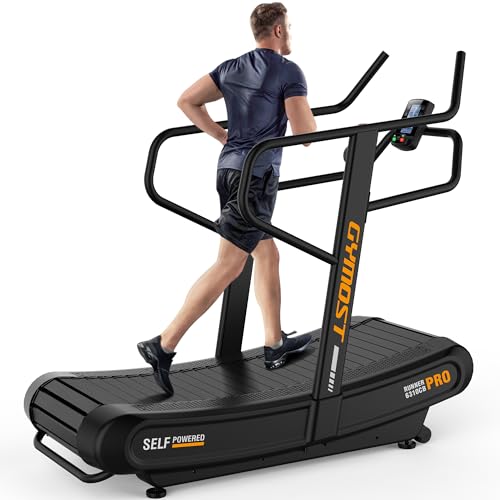
The GYMOST curved treadmill emphasizes an athlete‑powered run with four adjustable resistance levels. This non‑electric design relies on the runner to set pace, with a focus on engaging stabilizers and core muscles through the curved belt action. An LCD display and a remote or adjustable controls support tracking metrics like time, distance, and calories, while the multi‑position handles allow varied grip and posture during endurance work. The absence of a motor can be advantageous for technique work and cadence consistency under resistance training.
For distance runners, a curved, non‑electric path offers a different stimulus compared with motorized treadmills. The emphasis on user‑driven speed fosters efficient mechanics and muscular endurance, while the four resistance levels provide a scalable challenge for long, steady sessions or interval sets. This model is well suited for athletes who want to diversify training stimuli and reduce reliance on powered speeds during certain workouts.
UREVO Smart Treadmill Review

The UREVO Smart Treadmill pairs smart features with a versatile 3‑in‑1 folding design and a 9% incline. This 2‑display machine offers HIIT programs and an Auto Incline Follow Mode to adjust difficulty on the fly, supporting distance runners who incorporate hill simulations or fast tempo blocks. Running speeds cover a broad range from walking to running, enabling walkers to progress into longer runs. The foldable design and app connectivity provide practical options for home use, office workouts, or compact training spaces.
From a distance‑runner viewpoint, the combination of incline versatility, foldability, and integrated HIIT programs helps simulate varied race conditions and pace changes. The dual displays assist in tracking progress during long sessions, while the incline feature adds a scalable stimulus for endurance building. As with all smart treadmills, the value lies in how well the software and hardware integrate with your running plan and how reliable the incline mechanics prove over time.
Buying Guide
Choosing the best treadmill for distance runners involves balancing speed capability, belt size, and structural durability. Start with the belt: a longer, wider surface reduces stride restrictions during long tempo runs and comfortable cadence work. For distance training, a speed range that reaches or exceeds 12 mph supports sprint intervals within endurance workouts. If you value technical cadence and form, curved manual treadmills offer a unique stimulus that can improve efficiency, though they demand consistent drive power from the runner.
Motor power and incline matter, too. A robust motor (at least 3.0–4.0 HP in motorized models) provides steady performance over many miles, while an incline range expands training options for hill repeats and tempo climbs. For home gyms with limited space, foldable or compact designs help maintain a practical training area. Weight capacity is a practical consideration for durable use by heavier athletes or repeated loading during interval training.
Durability and warranty are essential for distance runners who train regularly. Look for a strong frame, long warranty on the frame and parts, and access to service if needed. Noise is another factor; quieter operation helps maintain focus during long sessions. If you plan to mix modalities (motorized, curved, and incline), consider models that offer compatible apps, tracking capabilities, and convenient integration with your training log.
Practical guidance for comparisons:
– Motorized treadmills with long belts and strong suspension are ideal for extended tempo runs and interval work.
– Curved treadmills emphasize propulsion mechanics and cadence, beneficial for sprint work and cadence drills.
– Non‑electric curved designs provide a low‑cost, low‑noise alternative that still supports high‑intensity work and endurance blocks.
– Incline features simulate hills and raise calorie burn, useful for endurance conditioning and strength development.
– Storage flexibility and ease of assembly should match your space constraints, especially for frequent training shifts between sessions.