Grip strength is a practical metric for athletic performance, rehab progress, and daily hand health. This guide highlights five top hand grip dynamometers and grip strength testers that balance accuracy, durability, and ease of use. Each model supports repeat testing, tracks profiles, and provides clear readouts to help you monitor gains over time. Use the quick comparison table below to scan max capacity, standout features, and direct Amazon links for workouts and clinics. The selections cover mid-range devices suitable for youth and adults, as well as higher-capacity testers for progressive strength training.
| Product | Brand | Max Capacity | Notable Feature |
|---|---|---|---|
| Handeful Grip Strength Tester | Handeful | 198 lbs / 90 kg | 19 user profiles, 0.2 lb / 0.1 kg divisions |
| HICHOR Grip Strength Tester Trainer | HICHOR | 265 lbs / 120 kg | 3-in-1 system with finger expander and palm ring |
| JTHEW Grip Strength Trainer | JTHEW | 400 lbs / 180 kg | Adjustable resistance trainer; 11–132 lb range |
| Handexer Grip Strength Tester | Handexer | 265 lbs / 120 kg | Backlit LCD; FDA registered |
| TIPRE Grip Strength Tester | TIPRE | 396 lbs / 180 kg | 19 profiles; adjustable ergonomic handle |
Handeful Grip Strength Tester

The Handeful device uses a high-precision strain gauge to measure grip strength up to 198 pounds, with a resolution of 0.2 pounds (0.1 kilograms). Its compact handheld design suits clinics, classrooms, and home gyms, enabling quick tests during practice or rehabilitation sessions. It supports up to 19 user profiles, including age and gender, to enable personalized progress tracking for individuals and teams. The unit recalls the last test per profile and visually indicates whether current strength has risen or fallen, aiding trend analysis. Two AAA batteries are included for immediate use.
- 198 Lbs / 90 Kg capacity with 0.2 Lb / 0.1 Kg divisions.
- 19 user profiles; age and gender data; last test recall; trend indicator.
- Includes two AAA batteries; ready to test out of the box.
- Compact, versatile for sports teams, clinics, schools, and home training.
HICHOR Grip Strength Tester Trainer
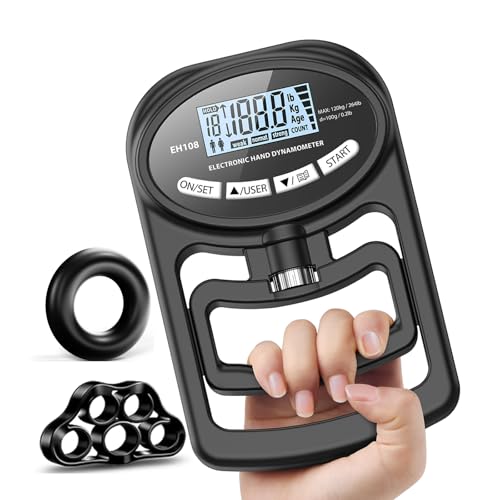
The HICHOR system blends a true 3-in-1 grip setup with a digital strength gauge. It includes a finger expander and palm ring to build finger and palm power, while the digital tester tracks progress in real time. It measures grip strength up to 265 pounds (120 kilograms) with 0.2 lb / 0.1 kg divisions, supporting consistent progress comparisons across workouts. It stores up to 19 profiles with age and gender and automatically shows incremental changes from the last test, aiding long-term training and rehabilitation benchmarks.
- 3-in-1 system: finger expander, palm ring, and digital tester.
- 265 Lbs / 120 Kg capacity; 0.2 Lb / 0.1 Kg precision.
- 19 profiles; age and gender data; automatic progress display.
- Real-time readings suitable for training and rehab programs.
JTHEW Grip Strength Trainer

The JTHEW system combines a high-precision grip strength tester with an adjustable resistance trainer. The tester measures up to 400 pounds (180 kilograms) with 0.2 lb / 0.1 kg divisions. The trainer offers adjustable resistance from 11 to 132 pounds, enabling science-backed, progressive training aligned with testing results. It records up to 19 user profiles and includes a smart counter to track how many squeezes you perform, providing a clear view of training volume and progress over time. This setup suits athletes seeking structured, measurable progress.
- Dual-function: tester plus adjustable resistance trainer.
- Max 400 Lbs / 180 Kg; 0.2 Lb / 0.1 Kg precision.
- 19 user profiles; smart counter for squeezes.
- Ideal for sports such as gymnastics, tennis, climbing, and more.
Handexer Grip Strength Tester

Handexer combines a high-capacity grip meter with a clear display and durable construction. It measures grip strength up to 265 pounds (120 kilograms) in 0.2 lb / 0.1 kg increments, offering precise results suitable for clinical testing and athletic training. A backlit LCD makes readings easy to view in dim environments, while the device is designed to support both testing and training contexts, helping clinicians and athletes gauge progress across programs. This model is often used in physical therapy and sports settings to benchmark improvements.
- 265 Lbs / 120 Kg max; 0.2 Lb / 0.1 Kg increments.
- Backlit LCD display for easy reading.
- FDA registered; suitable for rehab and clinical use.
- Versatile for testing and training in sports and therapy contexts.
TIPRE Grip Strength Tester

The TIPRE grip strength tester is built for high-capacity measurements and long-term training. It supports up to 396 pounds (180 kilograms) with 0.2 lb / 0.1 kg divisions and offers an adjustable ergonomic handle to fit different hand sizes. It stores up to 19 user profiles and automatically displays differences from the last test, enabling straightforward comparisons across sessions. This model is well-suited for athletes pursuing progressive overload, rehab patients, and classroom demonstrations where reliable, repeatable data matters.
- 396 Lbs / 180 Kg max; 0.2 Lb / 0.1 Kg precision.
- Adjustable ergonomic handle for diverse hand sizes.
- 19 profiles; automatic display of changes from the last test.
- Ideal for sports training, rehab, schools, and home practice.
Buying Guide
Accuracy And Capacity
When selecting a grip dynamometer, consider the maximum capacity you’ll realistically need. Models in this guide range from about 198 pounds to 396 pounds, with most offering 0.2-pound (0.1 kg) divisions for precise tracking. If you’re training for power in martial arts or climbing, a higher-capacity tester reduces ceiling effects and enables consistent progress measurement as you grow stronger. For clinic or school use, mid-range devices often provide ample range without unnecessary complexity.
Profile Tracking And Data Management
Multi-user profiles are a major advantage for teams, clinics, or families. The devices reviewed here commonly support 19 profiles and store key demographics (age, gender) to contextualize results. Look for features like last-test recall, automatic trend indicators, and a built-in counter or history log. These tools make longitudinal progress easy to visualize and share with coaches, therapists, or teammates, reducing guesswork when adjusting training plans.
Display, Ergonomics, And Durability
Readability matters: several models include a backlit LCD for dim spaces, while others rely on high-contrast displays. Ergonomic handles and adjustable grips accommodate different hand sizes, which is essential for accurate testing across populations. Build quality matters in busy environments; search for robust housings, reliable sensors, and, where applicable, FDA or medical-device registrations that indicate durability and safety for clinical use.
Use Scenarios And Value
Choose a device that aligns with your primary use case. For athletes and rehab patients, a combination tester and trainer (as in some models) can provide both measurement and progressive resistance in a single toolkit. If you need portability for field testing or classrooms, compact devices with long battery life are ideal. Compare not only initial cost but also ongoing value—such as data management, training features, and the ability to accommodate multiple hand sizes—as these aspects influence long-term effectiveness.
Across these options, the core decision factors are capacity, recording capability, and ease of interpretation. By balancing accuracy with practical features like profile storage and real-time trend indicators, you can select a grip dynamometer that supports clear, objective progress in strength training and rehabilitation.