GPS bike computers help riders stay on course while tracking performance, training load, and heart rate. When choosing a model, consider battery life, screen readability in sunlight, navigation capabilities, and whether solar charging or button-based controls or touchscreen interfaces fit your riding style. The five models below span solar-powered workhorses and compact navigators to robust touchscreen devices, offering varied balances of navigation, coaching, and data. Each option is suitable for riders who value accurate routing, fitness coaching, and reliable performance on demanding rides.
| Product | Brand | Key Feature |
|---|---|---|
| Garmin Edge 540 Solar | Garmin | Solar charging extends ride time; adaptive coaching |
| Garmin Edge 540 | Garmin | Compact GPS with button controls; adaptive coaching |
| COROS DURA Solar | COROS | 120-hour GPS battery life; solar charging |
| Garmin Edge Explore 2 | Garmin | Easy navigation; maps; eBike routing |
| iGPSPORT BSC300T | iGPSPORT | Touchscreen with offline mapping; multi-mode GPS |
Garmin Edge 540 Solar: Solar-Powered Navigation

The Garmin Edge 540 Solar builds on the standard Edge 540 with extended runtime courtesy of solar charging. In demanding use, it delivers up to 26 hours of operation, or up to 32 hours when solar charging is available in direct sunlight (75,000 lux). In battery saver mode, you can reach up to 42 hours, or up to 60 hours with solar. During daytime rides, solar can add roughly 25 minutes of extra runtime per hour in battery saver mode. This combination is particularly valuable for long endurance rides or multi-day events where access to power is limited.
Navigation and planning are core strengths, with advanced routing options, on-screen workout prompts, and performance-tracking metrics. The device supports personalized coaching that adapts to your current training load and recovery when used with a compatible power meter and heart rate monitor. The interface remains accessible via button controls, which can be advantageous in rain or when gloves reduce touchscreen usability. Overall, the Edge 540 Solar is suited to riders who need dependable navigation, extended battery life, and coaching that tailors workouts to real-time effort and recovery data.
iGPSPORT BSC300T: Touchscreen GPS Bike Computer
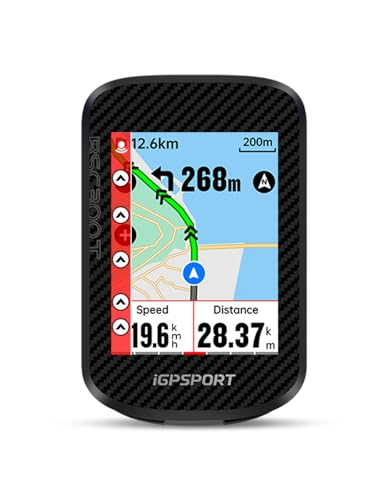
The iGPSPORT BSC300T provides a large 2.4″ touchscreen plus six physical buttons, giving riders flexible control options. It’s designed for multiple riding modes, accommodating road bikes, mountain bikes, and even e-bikes, with the ability to display power level and other vital metrics. Global satellite coverage supports GPS, Beidou, GLONASS, GALILEO, and QZSS to improve positioning accuracy and data reliability, even in challenging environments. The combination of a big display and multi-satellite compatibility makes it a practical choice for riders who value straightforward navigation and clear data readouts on the go.
With a waterproof design and a user-friendly interface, the BSC300T emphasizes reliability in varied weather conditions. Users can track ride time, distance, speed, altitude, and other core statistics, while the durable construction helps withstand routine cycling wear and weather exposure. This model is well-suited for riders seeking a cost-effective touchscreen device with robust GPS performance and simple data presentation for everyday training and weekend adventures.
Garmin Edge 540: Compact GPS with Coaching

The Garmin Edge 540 offers a compact GPS cycling computer with button controls designed for quick, reliable navigation and data access. It shares many core capabilities with the solar variant, including advanced navigation, performance tracking, cycling awareness features, and smart connectivity. In demanding use, you can expect up to 26 hours of battery life, with longer endurance available in battery saver mode (up to 42 hours). When paired with a power meter and heart rate monitor, the Edge 540 supports daily suggested workouts and training prompts to help optimize pacing and recovery across routes.
Personalized coaching is a standout feature, adapting to your event and training load. The device emphasizes a straightforward user experience through physical buttons that are easier to operate in wet or windy conditions. This model suits riders who want a reliable, compact navigator with coaching insights and strong battery efficiency without solar charging.
COROS DURA Solar: Long-Lasting Battery

The COROS DURA Solar focuses on exceptionally long battery life, boasting up to 120 hours of GPS use on a single charge. Solar charging adds up to two extra hours of ride time per hour of direct sunlight, enabling extended rides or multi-week training blocks without frequent recharges. The device uses a responsive touchscreen for intuitive control, complemented by a tactile digital dial and a single-button design that remains operable with gloves. Off-road trails, long bikepacks, and endurance riders can especially benefit from its balance of longevity and ease of use.
The DURA line emphasizes ease of use in adverse weather. The touchscreen supports gestures for quick navigation, while the dial and button design allow operation without fully removing hands from the bars. The solar enhancement is a practical feature for riders who prefer minimal interruptions due to charging, making it a strong option for weekend warriors and professionals alike who demand reliability on long trips.
Garmin Edge Explore 2: Easy Navigation

The Garmin Edge Explore 2 emphasizes beginner-friendly navigation and straightforward setup. It includes preloaded road, off-road, and indoor activity profiles, and its 3″ high-resolution touchscreen is designed to remain readable in bright sunlight and with gloves. The device supports improved ride-type maps that highlight popular roads and trails, making route planning easier for riders exploring new areas. eBike routing is also included, which helps riders navigate with appropriate motor-assist considerations while staying on familiar or new routes.
With simple-onboarding, cyclists can quickly get started and benefit from easy-to-read maps, context-aware routing, and reliable navigation on a glove-friendly screen. This model is particularly appealing for riders who value a low-friction experience, clear maps, and dependable navigation for daily commutes, tours, and exploring new routes without a steep learning curve.
GEOID CC600 Color Screen Bike Computer: Color Navigation

The GEOID CC600 offers a fresh 2.4” color display with durable Asahi glass and a straightforward three-button design. Its color navigation helps you stay oriented with turn reminders and on-screen notifications at turns. The CC600 supports uploading external GPX files via a mobile app and offers automatic re-routing to help you stay on course if you drift off track. WiFi and Bluetooth transmission ensure fast firmware updates and data synchronization, providing a modern, connected navigation experience for daily rides and weekend adventures.
Buying Guide
When selecting a GPS bike computer, buyers should weigh battery life, display readability, navigation depth, and how well the unit integrates with sensors and ride data ecosystems. For long endurance rides, solar charging and battery efficiency become decisive advantages. Riders who frequently ride in bright sun will benefit from high-contrast screens and glove-friendly controls. For those who map out complex routes or use offline maps, larger screens and robust routing features are crucial. Finally, consider how the device communicates with heart rate monitors, power meters, and smartphones to maximize training insights.
- Battery life and charging: Look for solar charging, battery saver modes, and real-world endurance under typical riding conditions. Solar options can dramatically extend field use during multi-day trips.
- Display and usability: Screen size, readability in direct sunlight, and whether the device uses buttons, touch, or both affect day-to-day usability on the handlebars and in wet weather.
- Navigation depth: Maps, offline routing, turn-by-turn directions, and GPX import/export enable advanced navigation across unfamiliar routes and remote regions.
- Sensor and ecosystem compatibility: Verify compatibility with power meters, HR monitors, BLE/ANT+ sensors, and training platforms to capture complete workout data and coaching prompts.
- Durability and water resistance: IP ratings and rugged construction help ensure reliability in rain, mud, and rough handling during rides.
- Display versatility: Glove-friendly screens and high-contrast visuals facilitate quick data checks without taking hands off the handlebars.
In practice, a solar-enabled model is ideal for riders who chase long rides or bikepacking trips where charging opportunities are limited. Compact devices with strong coaching features suit riders focused on structured training in base seasons. For everyday commuting and casual adventures, user-friendly navigators with clear maps and easy setup provide reliable performance with minimal setup. Evaluating how you ride most often will guide the best choice among these GPS bike computers for your particular cycling routine.